
7 Elliott Avenue Balwyn – James Buyer Advocates


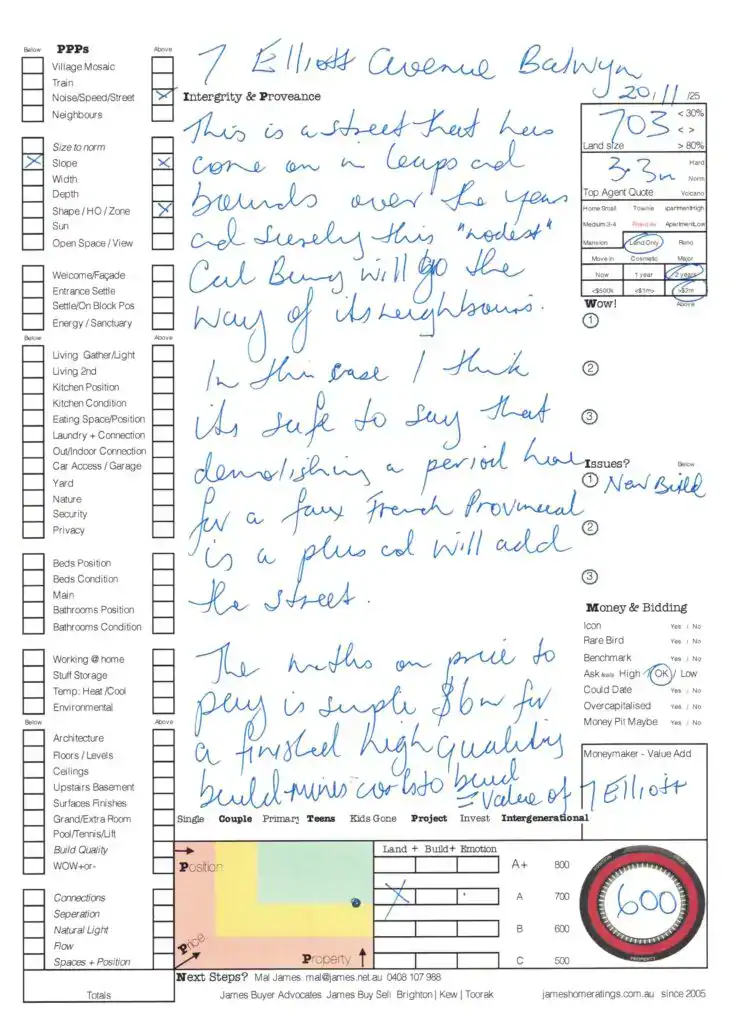




Modest House, Big Street Upside – 7 Elliott Avenue, Balwyn
7 Elliott Avenue is a very modest Californian bungalow sitting on around 703sqm in a street that’s clearly on the move. On either side you’ve already got substantial new homes/new homes sites, and there are more along the street – this is an area that has come on in leaps and bounds and will keep doing so. In that context, the existing home is really just a holding pattern, not the main event.
There’s no real architectural merit to preserve here, so the honest play is land and new build. In my view, replacing the period home with a well-designed, higher-end house would actually lift the street again. The value sits in what you can create: a quality family or intergenerational home that matches its neighbours and takes advantage of the improving position, not in trying to cosmetically rescue what’s already there.
If you’re working through numbers on what to pay, it’s a straightforward equation: start with what a finished high-quality home on Elliott is worth, take away realistic build and holding costs, and that gives you the land value. If you’d like help stress-testing those figures, sense-checking build budgets or comparing this with other Balwyn blocks, let’s talk before you commit.
📞 Mal James 0408 107 988 | ✉️ mal@james.net.au – James Buyer Advocates / James Buy Sell.

- Click Address through to Completed James Home Rating







James Home Ratings is a 25 year old, patented, 1500 buy/sells plus 1,000-point scoring system based on the 3 critical drivers of long-term property value:
Three Pillar Value Drivers
- POSITION — “Where money is attracted to”
Street appeal, precinct, orientation, land size, walkability, school zones - PROPERTY — “Where money is spent”
Flow, floorplan, architecture, renovation quality, future potential - PRICE — “What the market rewards”
Relative value vs price paid, cycle timing, agent positioning
Why It Works – Patterns
Because real estate, at its core, is about human behaviour—and history repeats itself.
Each home is scored independently and consistently, based on how it aligns with long-term demand and supply fundamentals for it’s specific area property type—that way you can compare a block of land with an apartment in different areas with different budgets..
A, B, C-Grade – Know the Difference
- A-Grade: Always in demand. Rare, proven, and resilient through market shifts.
- B-Grade: Good, but situational. Can work well when bought or sold smartly.
- C-Grade: Riskier. More emotion-driven, often overhyped, and harder to recover value.
What Others Do | What We Do |
Gut feel and emotion | Science and structure |
Agent spin and hype | Independent, consistent scoring |
Short-term trends | Long-term fundamentals |
Comparing apples to oranges | Same property type, different budgets, objectively assessed |
What the Scores Mean
- 500 – Maybe ok but it has serious issues to consider
- 600 – Average: Typical for many Inner Melbourne homes
- 700 – Above Average: Strong fundamentals, few weaknesses
- 800+ – Exceptional: A-Grade, no obvious dealbreakers, rare and highly sought-after
Know the difference, know your grade before you pay the price buying or selling.