
8 Currajong Avenue Camberwell – James Buyer Advocates


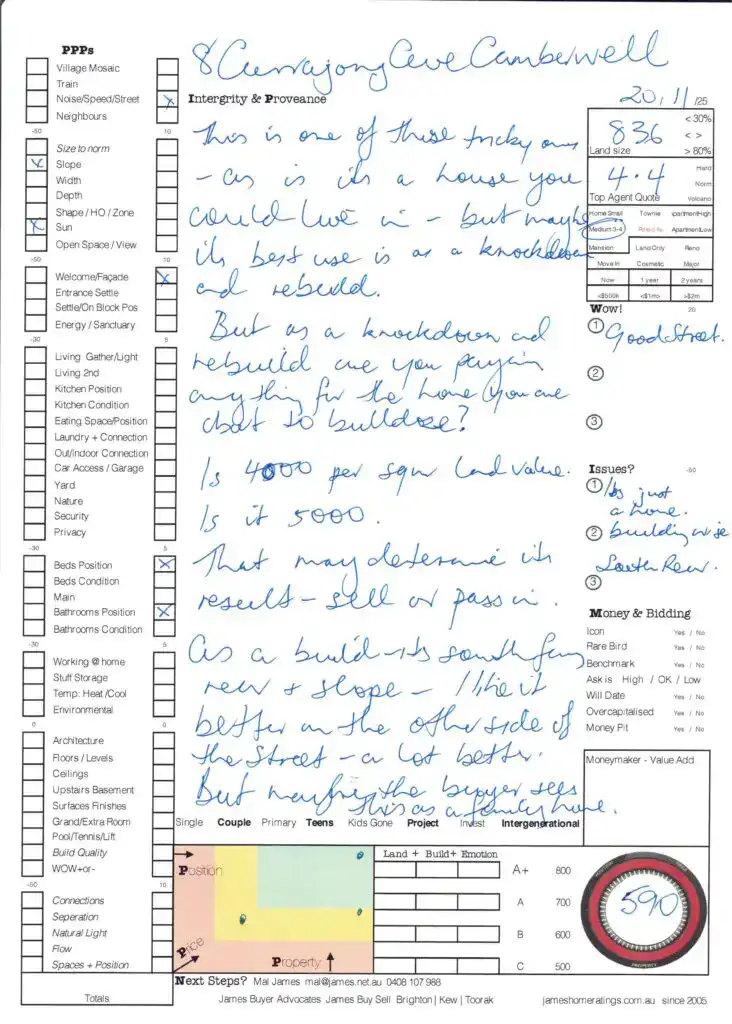




Great Street, South-Rear Question – 8 Currajong Avenue, Camberwell
8 Currajong Avenue is one of those tricky calls. On paper it’s a big 836sqm block in a really good street, with a substantial existing home you can move into straight away. The catch is the south-rear orientation and the fall to the back – classic Sunnyside/Camberwell Hill “sloping away” – which makes that all-important backyard connection harder to get right on any future new build.
The current house is solid and serviceable rather than exciting. There’s nothing dramatically wrong with it, but it’s not the sort of home you’d normally pour big renovation money into. With no heritage overlay, the long-term play is likely a knockdown and new family home once the timing and finances suit. If you do go that way, design will matter: you’ll need to work the slope and orientation cleverly so the living zones still feel light and connected to the garden.
So this becomes a price and preference decision. Do you like the street enough to accept the south-rear compromise, and are you paying land value or topping up for a house you’ll eventually bulldoze? If you’d like to stress-test the numbers on $/sqm, build costs and future value before you bid, let’s talk.
📞 Mal James 0408 107 988 | ✉️ mal@james.net.au – James Buyer Advocates / James Buy Sell.

- Click Address through to Completed James Home Rating







James Home Ratings is a 25 year old, patented, 1500 buy/sells plus 1,000-point scoring system based on the 3 critical drivers of long-term property value:
Three Pillar Value Drivers
- POSITION — “Where money is attracted to”
Street appeal, precinct, orientation, land size, walkability, school zones - PROPERTY — “Where money is spent”
Flow, floorplan, architecture, renovation quality, future potential - PRICE — “What the market rewards”
Relative value vs price paid, cycle timing, agent positioning
Why It Works – Patterns
Because real estate, at its core, is about human behaviour—and history repeats itself.
Each home is scored independently and consistently, based on how it aligns with long-term demand and supply fundamentals for it’s specific area property type—that way you can compare a block of land with an apartment in different areas with different budgets..
A, B, C-Grade – Know the Difference
- A-Grade: Always in demand. Rare, proven, and resilient through market shifts.
- B-Grade: Good, but situational. Can work well when bought or sold smartly.
- C-Grade: Riskier. More emotion-driven, often overhyped, and harder to recover value.
What Others Do | What We Do |
Gut feel and emotion | Science and structure |
Agent spin and hype | Independent, consistent scoring |
Short-term trends | Long-term fundamentals |
Comparing apples to oranges | Same property type, different budgets, objectively assessed |
What the Scores Mean
- 500 – Maybe ok but it has serious issues to consider
- 600 – Average: Typical for many Inner Melbourne homes
- 700 – Above Average: Strong fundamentals, few weaknesses
- 800+ – Exceptional: A-Grade, no obvious dealbreakers, rare and highly sought-after
Know the difference, know your grade before you pay the price buying or selling.